
 MoneyStatsReport Editors

In this article
- How Your Servicer Turns a Lump Sum Into a Smaller Payment
- Why Your Payment Falls by the Same Share as Your Balance
- What a $40,000 Mortgage Recast Does to a 3.25% Loan
- Why a Mortgage Recast Matters More With Rates Above 7%
- Who Can Get a Mortgage Recast and Who Usually Cannot
- What a Mortgage Recast Costs and How Long It Takes
- When a Mortgage Recast Is the Wrong Move
- Questions to Ask Your Servicer Before You Send the Check
- One Check Cannot Buy Both a Smaller Bill and an Earlier Payoff
Picture a homeowner holding an inheritance check. She does not want a new loan, a new closing, or a new 30-year clock. She has one question.
How can she make her house payment smaller without starting her loan over?
In October 2026, that question matters more than it has in years, because refinancing now means trading an older rate for one above 7%.
There is a cheaper tool that many servicers do not advertise unless a borrower asks for it by name. It is called a mortgage recast, and it comes with rules worth knowing before anyone writes the check.
How Your Servicer Turns a Lump Sum Into a Smaller Payment
A mortgage recast happens in two steps. You send your servicer a large lump sum that goes straight to principal, and the servicer recalculates your payment on the smaller balance over the months you have left. Your interest rate stays the same, and so does your payoff date.
Fannie Mae, which buys a large share of conventional loans, describes a recast loan as one re-amortized after a substantial principal curtailment, with the lower payment as the only change to the original note. Nobody pulls your credit, and nobody asks for tax returns, which is as close to romance as mortgage servicing gets.
Re-amortization means recalculating a payment schedule so the remaining balance is paid off in equal installments over the remaining term. A recast is re-amortization set off by your extra principal.
Why Your Payment Falls by the Same Share as Your Balance

Here is the part worth knowing before talking to a servicer. On a fixed-rate loan, when the rate and the remaining months stay the same, the monthly payment moves in direct proportion to the balance. Cut the balance by 14%, and principal and interest drop by 14%.
Every standard amortization schedule follows the same formula, so the ratio holds as a quick test of any mortgage recast quote.
Divide your lump sum by your current balance, and the result is roughly how much your principal and interest payment should fall.
Taxes and insurance are another story. The escrow part of your bill does not shrink with a recast, so the total amount you pay each month falls by less than that percentage. The county tax office, sadly, does not care about your lump sum.
What a $40,000 Mortgage Recast Does to a 3.25% Loan
For this example, we built a spreadsheet and named it Smaller Check. The hypothetical borrower took a $320,000, 30-year loan at 3.25% in late 2021. After 60 payments, the balance is $285,781.62, and principal and interest come to $1,392.66 a month.
| Option | Monthly principal and interest | Final payment | Interest from here on |
| Keep paying as scheduled | $1,392.66 | 2051 | $132,016 |
| Send $40,000, no recast | $1,392.66 | 2046 | $88,931 |
| Send $40,000 and recast | $1,197.73 | 2051 | $113,539 |
| Refinance the remaining $245,782 at 7.40% for 30 years | $1,701.74 | 2056 | $366,846 |
The mortgage recast trims the payment by $194.93 and saves $18,478 in interest. A $250 fee would be recovered in about two months.
Refinancing at the current average rate raises the payment even after the $40,000, which is the whole argument for a recast in one row.
Why a Mortgage Recast Matters More With Rates Above 7%
Freddie Mac put the average 30-year fixed rate at 7.40% on October 8, 2026, up from 6.30% a year earlier. I tracked the climb when 30-year mortgage rates moved back above 7% in September.
Meanwhile, most homeowners still hold loans from a cheaper era. Federal Housing Finance Agency data for the second quarter of 2026, summarized by Calculated Risk, breaks down outstanding fixed-rate mortgages this way.
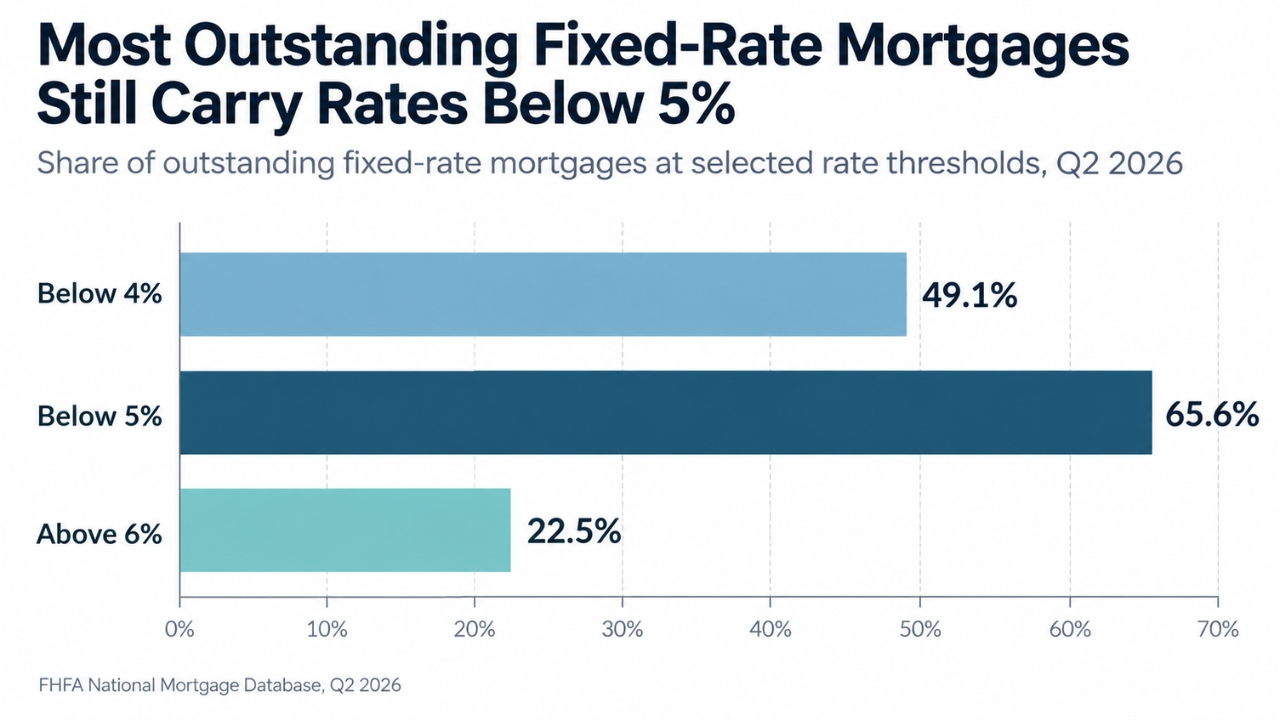
For the two larger groups, refinancing to lower a payment means paying more interest on every dollar borrowed. A mortgage recast keeps the old rate and still shrinks the bill.
Never trade in something that works fine.
Who Can Get a Mortgage Recast and Who Usually Cannot

Recasting is a servicer policy, not a legal right, so your first phone call decides everything. Conventional loans are the usual candidates.
Government-backed loans generally are not, and Chase, for one, states on its recast page that FHA, VA and USDA loans do not qualify. Servicers that allow a mortgage recast tend to ask for some combination of the following.
- A minimum lump sum, often $5,000 or $10,000, though some servicers set none.
- A record of on-time payments, sometimes as short as two to six months.
- Approval from the investor that owns your loan, which can change if the loan is sold.
- A loan in good standing on the day you ask.
Buyers who purchase a new home before selling the old one are frequent users. They close on the new house, sell the old one, and then apply the sale proceeds to lower the new payment.
What a Mortgage Recast Costs and How Long It Takes
Fees for a mortgage recast are small next to refinancing. Recasting fees typically run $150 to $500, there is no appraisal or credit check, and the process usually takes 45 to 60 days while you keep making the old payment.
A Fidelity editor who recast her own loan reported in early October a $250 fee, a $10,000 minimum, and about four months from her first call to the lower payment.
Paperwork is light. Expect a written proposal with the new payment, a short agreement to sign, and a check or wire for the lump sum plus the fee.
Did you know? If your down payment was under 20%, the same lump sum can also end private mortgage insurance. Federal rules let you request PMI cancellation once your balance reaches 80% of the original value, including through extra payments, if you are current and the home has held its value.
When a Mortgage Recast Is the Wrong Move

A recast lowers your payment, but it saves less interest than plain prepaying. In our example, the same $40,000 saves $43,085 without a recast and $18,478 with one. The gap is the price of a smaller monthly bill.
Some borrowers deliberately take the other side of that trade. They send extra principal for years and never ask for a recast, because the goal is to have the loan gone, not cheaper. A lower required payment can make it tempting to slow down.
Cash is the other risk. Money sent to principal does not come back easily, and borrowing it out again through a home equity line costs real interest, as we covered when HELOC rates posted their biggest jump of 2026.
A mortgage recast by itself never moves your payoff date. Extra principal paid without a recast does.
A mortgage recast cannot remove an ex-spouse as a borrower. Our guide to mortgage debt after divorce explains why the lender must approve a release.
Questions to Ask Your Servicer Before You Send the Check
Servicers answer the question you ask, not the one you meant. Before any money leaves your account, get clear answers to these five questions about your mortgage recast, ideally by email so you have them in writing.
- Does the investor that owns my loan allow a recast, and what is the fee?
- What is the minimum lump sum, and is it applied to principal the day it arrives?
- How long until the new payment starts, and do I keep paying the old amount until then?
- Can I see the new payment and amortization schedule before I sign?
- Will my escrow payment change at the same time, or on its own schedule?
Keep every answer with your loan papers. If the servicer changes hands next year, those emails are your proof.
One Check Cannot Buy Both a Smaller Bill and an Earlier Payoff
View this post on Instagram
Back to the homeowner with the inheritance check. She wanted a smaller payment and a loan she could keep, and a mortgage recast gives exactly that, as long as the servicer allows it.
If you hold a loan below 5% and a lump sum is coming from a bonus, an inheritance, or the sale of an old house, call your servicer before the money lands.
Divide the lump sum by your balance to estimate the payment cut. Then decide what matters more, a smaller bill or an earlier last payment, because the same check cannot buy both.