
 MoneyStatsReport Editors

In this article
- What the 20-point gap actually means
- Participation slipped while access stayed unchanged
- Part-time and lower-paid workers have less retirement coverage
- Debt payments can leave less room for retirement savings
- Put an employer match into actual dollars
- Automatic enrollment still needs your attention
- Ask payroll for a dollar figure
- Ask yourselves:
- 1. Can I also contribute to an IRA?
- 2. Are Roth 401(k) withdrawals always tax-free?
- 3. Where can I check investment costs?
- 4. Should I update my beneficiary after divorce?
- 5. Who can help with a benefits dispute?
- Check what reaches your account next payday
The distance between being offered a retirement benefit and actually receiving it gets less attention than it deserves. A benefits brochure cannot make a retirement contribution.
The Bureau of Labor Statistics release published September 25, 2026, puts that distance at 20 percentage points. In March 2026, 72% of private-sector workers had access to retirement benefits, but only 52% participated.
Before anyone starts scolding the workers who are not enrolled, the numbers deserve a careful reading. They do not show that everyone outside a plan ignored free money. They show that offering retirement benefits and getting workers covered are two different achievements.
What the 20-point gap actually means
View this post on Instagram
Picture 100 workers when a percentage starts getting slippery. Using the rounded BLS figures, 72 have access to retirement benefits, 52 participate, and 28 have no access through their employer.
Among workers with access, the published participation share, called the take-up rate, is 72%. Saying only 52% of eligible workers enroll would use the wrong denominator.
Access means a benefit is available. Participation means a worker meets the survey’s participation conditions. Take-up measures participation among workers with access.
The BLS definitions also distinguish contributory and noncontributory plans. Required contributions and service conditions affect how workers are counted.
Employer-funded plans can count workers without employee contributions.
The gap isn’t a head count of people refusing a 401(k) match. I wouldn’t put that accusation in a spreadsheet, much less a headline.
Participation slipped while access stayed unchanged
The March 2025 BLS figures showed the same 72% access rate, with 53% participating. The latest estimate is one percentage point lower, widening the reported gap from 19 points to 20.
That small movement shouldn’t be turned into a collapse. Survey estimates have uncertainty, and a year-to-year difference alone doesn’t explain its cause.
The 2026 report also separates the plans workers can access:
- 70% had access to defined contribution plans, including 401(k)-style accounts.
- 14% had access to defined benefit plans, including traditional pensions that may offer a monthly pension or lump sum payout at retirement.
Some workers have both, so adding those percentages would double-count people. Nor does participation tell us how much someone has saved.
A worker contributing a small amount and a worker with decades of savings can both appear in the participation column. Coverage is a starting measurement, not a retirement-readiness score.
Part-time and lower-paid workers have less retirement coverage
National averages make very different jobs look like one standard workday. My benefits-data job doesn’t resemble a part-time service job, and the retirement numbers shouldn’t pretend otherwise.
The March 2026 retirement coverage table shows the difference within private industry:
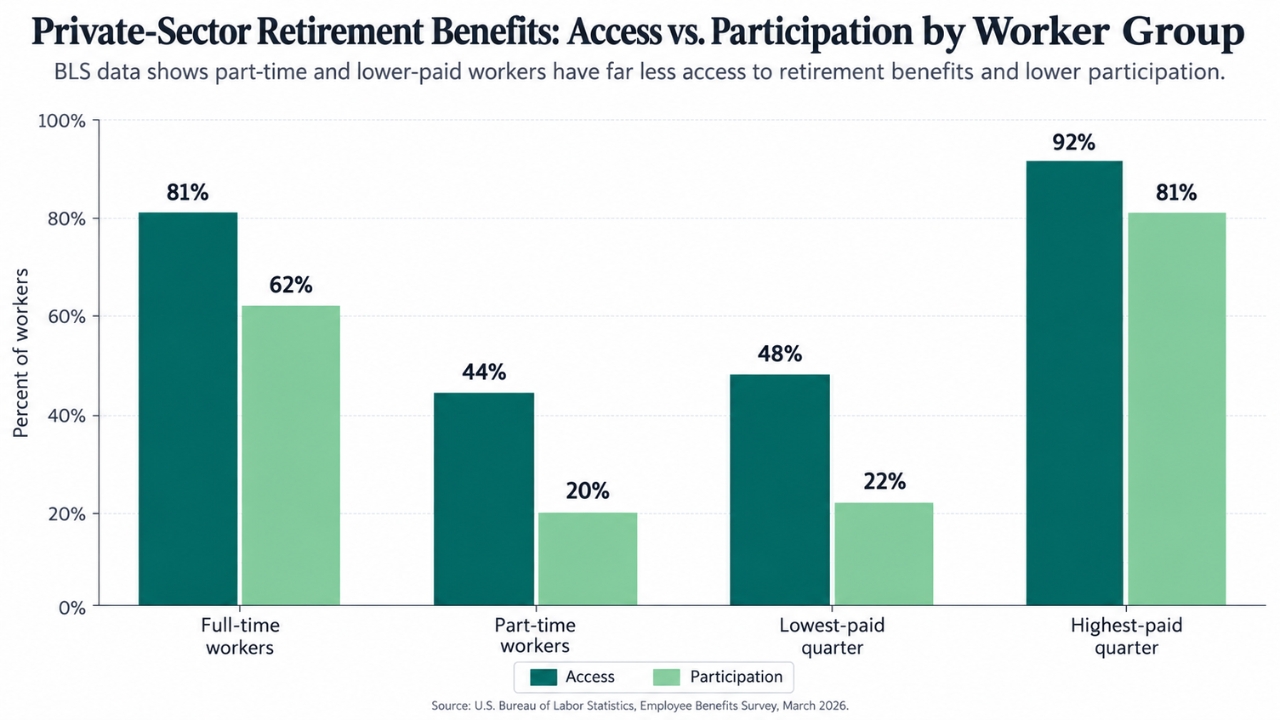
The wage categories reflect occupational wages, not total household income. Even with that limit, the contrast deserves attention.
Two questions come up.
Does the job provide a retirement benefit at all? If it does, can the worker participate under the plan’s terms and household budget?
A reminder email might address forgotten enrollment. It can’t create a benefit where none is offered. Telling every worker to complete the same form skips the first problem entirely.
Debt payments can leave less room for retirement savings
Retirement advice often starts with “just.” Just save more. Just cut something. The arithmetic may be simple, but the decision is harder when debt already takes a large share of each paycheck.
For employees with student loans, a student loan match may provide employer retirement contributions even if they cannot afford regular 401(k) deposits.
Card debt reached $1.26 trillion in the second quarter, and our credit card rates comparison shows how a higher APR can add thousands of dollars to a payoff. Housing adds pressure too. With 30-year mortgage rates above 7%, new homebuyers may have less room in their monthly budgets for retirement contributions.
Existing homeowners face similar pressure. HELOC rates saw their largest weekly increase of 2026 after the Fed’s September rate hike, potentially raising interest costs for households with variable-rate home equity lines.
The total home equity line of credit debt reached $459 billion in June, up $48 billion in a year.
Mortgage debt adds another major household obligation. Americans now carry $13.1 trillion in mortgage debt, another financial commitment that can affect how much money remains available for retirement savings.
Americans are carrying more credit card debt as balances climb to $1.26 trillion, putting the country within striking distance of last year’s record high. The New York Fed says card debt rose by $21 billion in the second quarter, reflecting continued spending pressure as many households keep absorbing higher costs for everyday needs like food and gas.
— Money (@Money) August 12, 2026
Those balances provide context, not proof that debt caused the BLS participation gap. The reports don’t connect individual borrowers to enrollment decisions.
I’d discuss cash flow, debt payments, and available employer contributions together before prescribing one savings percentage to everyone.
Put an employer match into actual dollars
When a plan offers matching contributions, we want the formula translated into money before anyone decides it’s too small to investigate.
Consider a hypothetical worker earning $50,000 whose employer matches contributions dollar for dollar up to 4% of eligible pay:
- The worker contributes $2,000 over a full year.
- The employer adds another $2,000 under that assumed formula.
- The account receives $4,000 before investment results and fees.
That’s an illustration, not a promise about your employer. Some plans don’t match, and matching formulas differ.
Also check the vesting rules governing ownership of employer contributions. Your own salary contributions are always yours. Employer contributions can depend on service requirements.
Automatic enrollment still needs your attention

Under automatic enrollment, payroll contributions begin unless the employee declines or selects another amount. We like removing an administrative hurdle. We also like checking what payroll actually did.
A legal change is already in effect. As IRS guidance on SECURE 2.0 explains, certain 401(k) and 403(b) plans established on or after December 29, 2022, must automatically enroll eligible workers for plan years beginning after 2024. Exceptions apply, so don’t assume every employer must do it.
Even when enrollment is automatic, the starting contribution isn’t a personalized savings recommendation. Check the percentage, investment selection, and any scheduled increases.
We wouldn’t assume a default contribution captures the full match either. Compare it with your plan’s formula. Getting enrolled resolves one step. Understanding what leaves your paycheck, and what arrives in the account, is the next.
Automatic enrollment does not guarantee that your savings stay invested after a job change. Vanguard found that some savers moved their retirement money into an IRA and left it in cash for years without realizing it.
Ask payroll for a dollar figure

Our first step would be opening the benefits portal with a recent pay stub beside it. We want the actual election and deduction, not memory of a presentation during orientation.
If anything is unclear, ask the benefits team:
- Am I eligible now, and when can contributions begin?
- What contribution earns the full employer match, if one exists?
- What would that election change in each paycheck?
- When do employer contributions become fully vested?
The Summary Plan Description explains the plan’s main provisions. Ask for it if the portal leaves you guessing.
Then compare the payroll estimate with essential expenses and debt obligations. If the full matching threshold isn’t affordable, ask about a smaller starting election and set a date to reconsider it. A manageable contribution deserves a plan for review, not a lecture.
Ask yourselves:
1. Can I also contribute to an IRA?
Yes. IRA eligibility and deduction rules still apply, including income restrictions, compensation requirements, and contribution limits.
2. Are Roth 401(k) withdrawals always tax-free?
No. Qualified Roth distributions require a five-tax-year holding period plus age 59½, disability, or death.
3. Where can I check investment costs?
Request the plan’s investment comparison chart and fee disclosures. The Labor Department’s fee guide explains what to examine.
4. Should I update my beneficiary after divorce?
Review the designation with your administrator. Plan rules, spousal protections, and any applicable court order can affect who receives benefits.
5. Who can help with a benefits dispute?
For private workplace plans covered by ERISA, Employee Benefits Security Administration assistance is available at 1-866-444-3272. Keep statements and correspondence.
Check what reaches your account next payday

A retirement deduction deserves attention even after the biggest bills are gone. Small payroll numbers are easy to stop checking, and a mistake there can run for months before anyone notices.
Before the next payroll cutoff, confirm your enrollment, contribution percentage, and matching terms.
After payday, compare the deduction with the activity in your retirement account, allowing for the deposit timing of your plan.
If anything does not match your election, ask payroll to explain it. If you are not yet eligible, get the eligibility date in writing and put it on your calendar.