 MoneyStatsReport Editors
In this article
- What the Edmunds Numbers Actually Measure
- Why Seven Years Starts to Look Reasonable
- What 84 Months Costs on an Average Loan
- How an Old Car Loan Follows a Trade-In
- Regulators Flagged Long Loans Years Ago
- The Car Loan Interest Deduction Has Limits
- Rates Are Moving Again, and I Am Not Guessing Where
- What to Check Before You Sign a Long Loan
- The Number to Write Down First
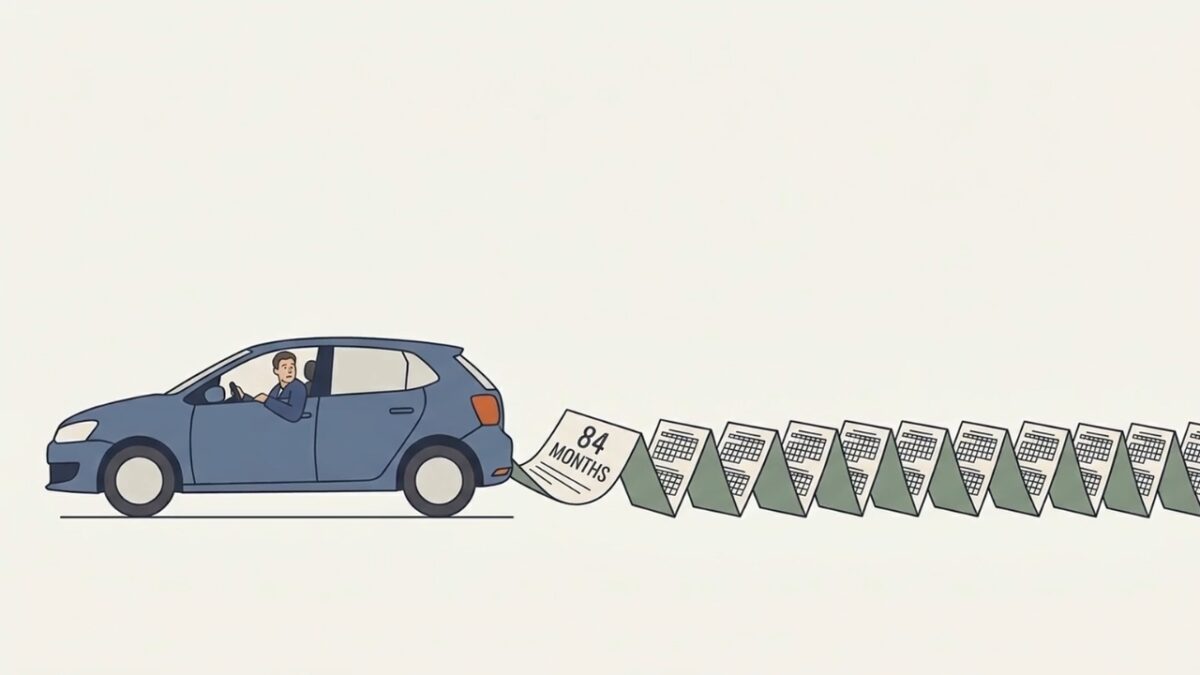
A record 25.5% of financed new-car purchases in the third quarter of 2026 came with loans of 84 months or longer, according to Edmunds data. A year earlier, the share was 21.8%.
Seven years is a long time to owe money on something that loses value every time it backs out of the driveway. Still, most people signing these loans are not careless.
They are solving for a monthly payment on a price that keeps climbing, and the math has a catch worth seeing before signing.
What the Edmunds Numbers Actually Measure
Several headlines blur what the 25.5% covers. The figure is a share of new vehicles bought with financing in the Edmunds data, as stated in the Edmunds third-quarter financing report released October 1.
View this post on Instagram
Cash buyers and leases are not part of it, and it is not a count of every auto loan in the country.
| New-vehicle financing | Q3 2025 | Q2 2026 | Q3 2026 |
| Loans of 84 months or longer | 21.8% | 23.9% | 25.5% |
| Average amount financed | $42,744 | $44,156 | $44,664 |
| Average monthly payment | $756 | $777 | $787 |
| Average APR | 7.0% | 7.0% | 7.0% |
| Average down payment | $6,021 | $5,815 | $5,554 |
Look at the APR row. The rate did not move in a year, yet payments rose $31. Buyers borrowed $1,920 more and put $467 less down, so the longer term is what kept the monthly number from rising further.
Why Seven Years Starts to Look Reasonable
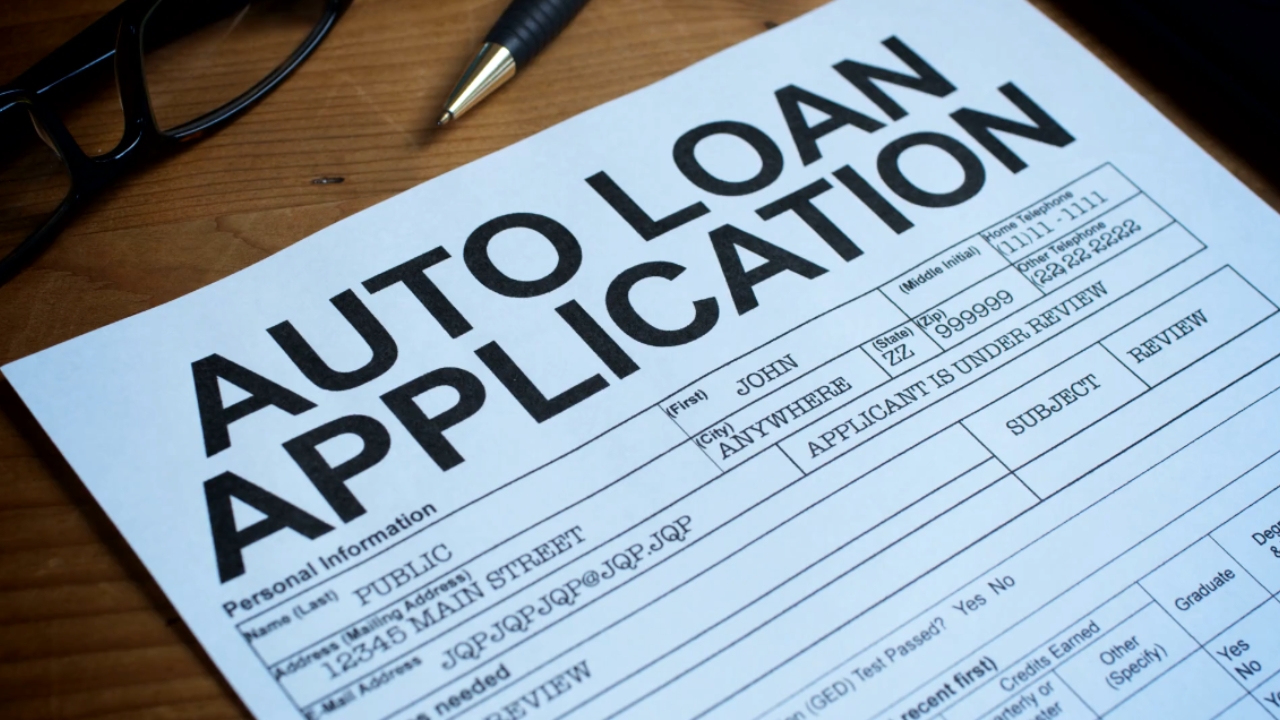
Many car buyers can quote their monthly payment to the dollar but are far less sure what the car actually cost. The latest Edmunds figures show what that habit looks like at current prices.
- A record 21.2% of financed new-car buyers agreed to $1,000 or more a month, up from 19.1% a year earlier.
- Among those $1,000-a-month buyers, 69% chose terms of 72 months or longer.
- Average interest over the life of a new-car loan reached a record $9,938, even with the APR flat.
Apart from finding a lower interest rate, a longer term is the main lever that lowers the payment without lowering the price. Everything else, like a bigger down payment or a cheaper trim, asks the buyer to give something up today.
What 84 Months Costs on an Average Loan
We ran the numbers using the Q3 average amount financed of $44,664 and an average APR of 7.0%.
The figures below are our own calculations, not Edmunds data, and they leave out sales tax, fees, insurance, and the higher rates some lenders charge on longer terms.
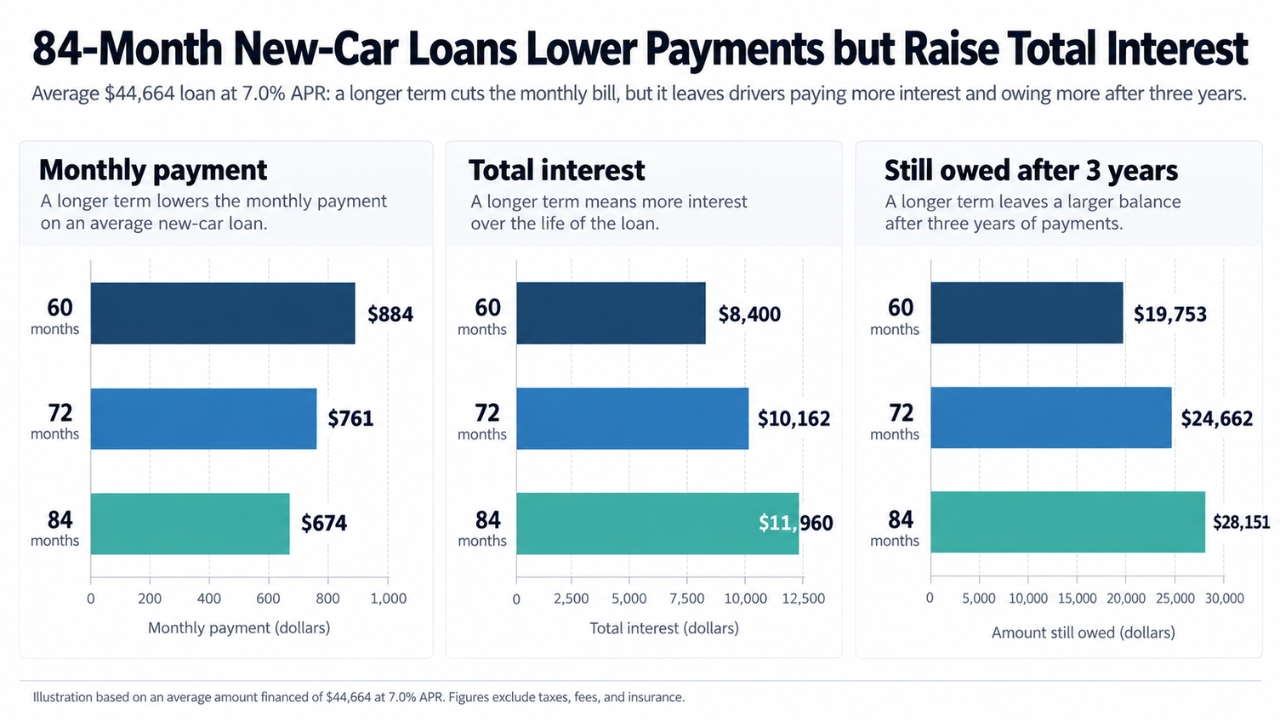
Going from five years to seven saves $210 a month and costs $3,560 more in interest. The last column matters more. After three years, the seven-year borrower still owes about $8,400 more than the five-year borrower on the same car.
How an Old Car Loan Follows a Trade-In
On many credit reports, a car loan is one of the largest monthly payments after housing. Some borrowers are still paying for a car they no longer own, because the old balance was folded into the new loan at the dealership.
Negative equity means you owe more on a vehicle than it is worth. When you trade it in, the shortfall does not disappear. It is usually added to the loan on your next car, and you pay interest on it again.
Our report on how dealers add old car debt to a new loan explains where that balance appears in the contract and how much extra interest it can cost.
The latest Edmunds negative equity figures for the second quarter put 29.6% of new-car trade-ins underwater, with an average of $6,884 owed. Those buyers averaged $944 a month and a projected $16,270 in lifetime interest. A seven-year loan makes it more likely to land in that group when trading in early.
Regulators Flagged Long Loans Years Ago
Long auto loans are not a new worry, just a bigger one. The Fed data on unpaid household bills add context: 3% of U.S. adults did not pay their car bill in full in 2024.
A 2017 Consumer Financial Protection Bureau report on longer-term auto loans found that loans of six years or more defaulted at rates above 8%, about double the rate for shorter loans. Borrowers who took them also had lower credit scores on average.
The current picture comes from the New York Fed household debt report for the second quarter. Auto loan balances stood at $1.71 trillion, and 3.00% of balances moved into serious delinquency on an annualized basis, compared with 2.93% a year earlier.
The bank described new auto delinquencies as elevated. That is a confirmed measurement, not a prediction of what comes next.
The Car Loan Interest Deduction Has Limits
Some buyers assume the new federal deduction for car loan interest makes a longer loan cheaper. It can help, but only if the purchase fits the rules. The IRS explanation of the car loan interest deduction sets out several conditions.
- It covers tax years 2025 through 2028, for loans taken out after December 31, 2024.
- The vehicle must be new and for personal use. Used cars and leases do not qualify.
- Final assembly must happen in the United States.
- The deduction is capped at $10,000 of interest a year.
- It phases out above $100,000 of modified adjusted gross income, or $200,000 for joint filers.
A deduction lowers taxable income. It does not refund the interest, so a seven-year loan still costs more than a five-year one. You can check where a car was assembled with the NHTSA VIN decoder, which lists the plant of manufacture.
Rates Are Moving Again, and I Am Not Guessing Where
The Federal Reserve raised its target range by a quarter point to 3.75% to 4.00% in its September 16 policy statement, its first increase in three years.
Breaking news: The Federal Reserve has raised interest rates by a quarter point to a range of 3.75% to 4%, as widely expected by economists.
Follow live updates: https://t.co/0tLqMqEz5m https://t.co/ffKmeHXPA6
— Financial Times (@FT) September 16, 2026
Auto loan rates tend to track longer-term Treasury yields more closely than the Fed rate itself, much like mortgage rates do. We covered that link when 30-year mortgage rates climbed back above 7% in September.
The 7.0% average auto APR in the Edmunds data covers the third quarter, so it captures only a slice of the September moves.
Will the 84-month share keep rising? Honestly, I do not know. My Wrong Jar for missed forecasts already holds enough to fill a gas tank, so we will leave the prediction to braver people and stick to what the data confirms.
What to Check Before You Sign a Long Loan
Edmunds analysts told buyers to judge a loan by its full cost over its life, not only by whether the payment fits this month. Before you sign, run through four checks.
- Ask the dealer for a 60-month quote next to the 84-month quote, and compare the total of payments on each.
- Get a preapproval from a credit union or bank first, so the dealer rate has something to beat.
- Keep the loan shorter than the time you expect to own the car. If you trade every five years, a seven-year loan builds negative equity into the plan.
- Price a cheaper trim or a late-model used car. Used loans averaged 10.6% APR in Q3, so compare total cost rather than rate alone.
The Number to Write Down First
Before comparing payments, write down the total you will pay, interest included. Every other decision about the loan should start from that number.
At the dealership, multiply the monthly payment by the number of months and write the result on the sales sheet before you sign.
On the average $44,664 balance stretched over 84 months at 7%, that total comes to about $56,600. If the number is a surprise, ask for the 60-month quote too. The payment rises to roughly $884 a month, but the total falls to about $53,100, a saving of around $3,500 in interest.