
 MoneyStatsReport Editors

In this article
- What Vanguard Found When It Followed the Money
- Why Rollover Money Lands in Cash
- What Savers Said When Vanguard Asked Them
- What the Cash Cost, by Age at Rollover
- Our Own Math on a $50,000 Rollover
- Not All Cash in an IRA Pays the Same
- How to Check Your Own Rollover Today
- What Is Settled and What Is Still Only a Proposal
- The One Line Worth Reading on Your Statement
In a Vanguard study of about 68,000 rollovers made in 2015, 28% of the savers still held their money in cash seven years later. They had done the hard part.
Forms were filed, the old 401(k) moved, and then the money sat in a money market fund while the markets kept moving without them.
The paperwork is where many savers stop paying attention, because moving the money feels like the finish line.
It is really the halfway mark. Below is what the research found, what the cash cost, and how to check your own account in a few minutes.
What Vanguard Found When It Followed the Money

Vanguard published the research in July 2024 as a study of what it calls the sticky IRA cash trap. The team looked at rollovers of at least $1,000 that arrived in Vanguard IRAs as cash during 2015, then tracked trading through the end of 2022. An account had to hold a balance at year-end 2022 to count.
The age pattern bothered me more than the headline number.
- Among savers in their 20s, 53% had made no trade after seven years.
- For savers 60 and older, the share was 15%.
- A separate 2022 sample found 28% of new rollover investors still in cash after 12 months, compared with 55% of people who made direct IRA contributions.
Younger savers, who generally have smaller average 401(k) balances and more decades ahead of them, were the most likely to leave the money alone.
Why Rollover Money Lands in Cash
Inside a 401(k), money you never direct usually goes into a default fund, often a target-date fund, which federal rules allow. Once you roll the money into an IRA, those rules no longer apply.
Most rollovers arrive at the new firm as cash and wait in a money market fund or a bank sweep until you choose. Doing nothing in a 401(k) still gets you invested.
In an IRA, doing nothing gets you cash. The Labor Department finalized the rule below in 2007, and the gap between workplace plans and IRAs has existed ever since.
A qualified default investment alternative, or QDIA, is the investment a 401(k) uses when a worker gives no instructions. Under the Labor Department final rule issued in October 2007, it can be a target-date fund, a balanced fund, or a managed account. A capital preservation product counts only for the first 120 days.
What Savers Said When Vanguard Asked Them
Vanguard later surveyed 556 people who rolled a 401(k) into a Vanguard IRA in 2023 and still held a money market fund in June 2024. The survey results, published in October 2024, show that most were not making a cautious bet. They simply did not know. People could give more than one reason, and the answers broke down like so.
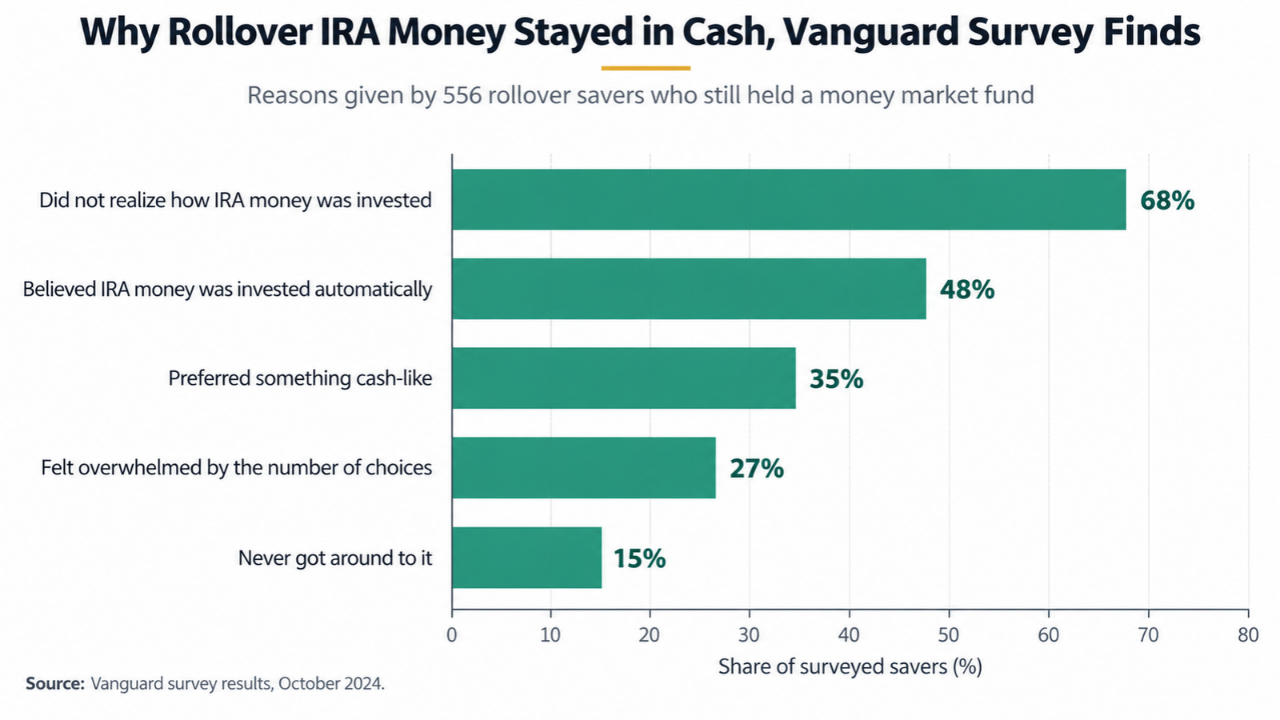
And 77% had owned investment accounts before, so experience did not protect them. Plenty of workers leave a free employer match unclaimed, often because nobody explained how it works. The rollover version is the same problem, only with a bigger balance attached.
What the Cash Cost, by Age at Rollover
The policy paper behind the study, Improving Retirement Outcomes by Default, estimates how much more each saver would have at 65 if the money had gone into a target-date fund at rollover.
| Age at rollover | Median income used | Median time in cash | Estimated extra wealth at 65 |
| 25 | $62,000 | 7 years | $130,182 |
| 35 | $80,000 | 2 years | $164,406 |
| 45 | $83,000 | 1 year | $163,189 |
| 55 | $97,000 | 5 months | $66,837 |
The reported figure of at least $130,000 matches the age-25 row, the lowest estimate for anyone who rolled over before 55. Vanguard built the estimates from its own return simulations as of November 2023, so they are projections, not results.
Scaled up with IRS rollover counts for 2020, Vanguard puts the total at more than $170 billion in retirement wealth each year.
Our Own Math on a $50,000 Rollover

We ran a simpler version for a $50,000 rollover left alone for seven years, the stretch Vanguard tracked. The inputs are flat yearly returns, annual compounding, and no new deposits. The rates are our assumptions, not forecasts, and they are labelled that way on purpose.
At 0.5%, standing in for a low-paying bank sweep, the money grows to about $51,776. A 3.5% rate, a little under the 3.75% to 4% range the Fed set in September 2026, brings it to about $63,614. In a diversified mix earning 6%, it reaches about $75,182.
So a decent money market fund trails the 6% mix by $11,568, and a weak sweep trails the money market fund by another $11,837. Real returns change every year, and stocks can fall.
Not All Cash in an IRA Pays the Same
“Cash” on a brokerage statement can mean three different things. The SEC investor bulletin on cash sweep programs, from May 2025, lists money market fund sweeps, bank sweeps, and a plain free credit balance. Some firms default you into a bank sweep, which the SEC notes often pays less than a money market sweep.
Did you know? In January 2025, Wells Fargo and Merrill Lynch agreed to pay a combined $60 million to settle SEC charges over their cash sweep programs for advisory clients. The SEC found that when rates were rising, the yield gap between those bank sweeps and other options at times reached almost 4 percentage points. Neither firm admitted or denied the findings.
Bank sweeps carry FDIC coverage up to $250,000 per bank. Money market funds do not, though they may have SIPC protection at the brokerage.
How to Check Your Own Rollover Today
You only need your login and about ten minutes.
- Open the holdings or positions page, not the balance summary. A single line for a money market fund, a settlement fund, or cash holding most of the balance tells you the money never got invested.
- Find which sweep option the account uses and what it pays. If the statement does not say, ask the firm.
- Decide whether the cash is on purpose. Money you plan to spend in the next few years can reasonably stay there.
- If it is not on purpose, choose an investment and check its expense ratio. A target-date fund is what most 401(k) plans use as the default.
If you move a 401(k) or choose a pension lump sum instead of monthly payments, ask for a direct rollover to an IRA, provided the distribution qualifies.
Still planning a rollover? Ask for a direct one. Under IRS rollover rules, a check paid to you from a plan comes with 20% withheld, and you have 60 days to finish the move.
View this post on Instagram
What Is Settled and What Is Still Only a Proposal
The cash numbers are confirmed, but they cover Vanguard clients only, and the main cohort dates from 2015. Other firms may look different.
What Vanguard wants next is still a proposal. It argues IRAs should be allowed a default investment, like a target-date fund, with legal protection for firms that use one. As of October 2026, I found no bill in Congress to create that, so for now the decision stays with each saver.
Keep one more thing separate. You may have seen headlines about $2.1 trillion in “forgotten” 401(k) accounts.
That estimate counts money left behind in old employer plans, comes partly from a company that sells rollover services, and some retirement industry voices have questioned it. It describes a different problem from money that was moved and then never invested.
The One Line Worth Reading on Your Statement

If you rolled over a 401(k) at any point since your last job change, open that IRA this week and read the holdings line, not the total. One line that says money market or settlement fund at close to 100% is your answer. It might be on purpose, and that is fine if you know it.
When it is not on purpose, the fix takes about as long as reading this article. The people in the Vanguard study were not careless. Most had owned investments before. They assumed the IRA would behave like the 401(k). It does not, unless you tell it to.