 MoneyStatsReport Editors
In this article
- What the Fed Reported for August
- Two Card Rates, and Only One of Them Is Yours
- How August Compares With Spring and With Last Year
- Why Card Balances Shrank in August
- The September Rate Hike Is Not in These Numbers Yet
- What a Higher Card Rate Does to the Same Payoff
- Why Two Reports Disagree on Card Debt
- What to Check on Your Own Cards This Month
- What Comes Next
The average interest rate on credit cards rose to 21.19% in August, according to the latest Federal Reserve consumer credit report, released October 7.
In the same month, revolving balances fell by about $4.8 billion.
We read the release and our first reaction was not alarm. Rates went up a little. Balances came down a little.
Underneath those two small moves sits a bigger story about who actually pays 22% interest, why the September rate hike is not in these numbers yet, and what to check on your own statement before it shows up.
What the Fed Reported for August
The Fed tracks consumer borrowing every month in a report called the G.19. It covers credit cards, car loans, student loans, and personal loans.
August was a split month, with installment debt growing and card debt shrinking.
- Total consumer credit grew at a 1.9% annual rate, to about $5.2 trillion.
- Revolving credit, which is mostly credit cards, fell at a 4.2% annual rate to about $1.35 trillion.
- Nonrevolving credit, mainly auto and student loans, grew at a 4.1% annual rate to about $3.84 trillion.
- The average rate on all card accounts reached 21.19%, up from 20.94% in the second quarter.
- Every August figure is preliminary and can be revised next month.
KPMG senior economist Matthew Nestler called the revolving drop the largest monthly decline in almost two years. July went the other way, with revolving credit up at a 2.5% annual rate.
Two Card Rates, and Only One of Them Is Yours

Every time this report comes out, some headline grabs one card rate and runs with it. The Fed actually publishes two, and they describe different people.
That 21.19% figure includes every account, even the forgotten card in your kitchen drawer with a zero balance.
According to the Fed explanation of the G.19 data, the “all accounts” rate averages the purchase APR offered to every cardholder, whether or not they carry a balance.
The “accounts assessed interest” rate divides finance charges billed by the balances they were charged on, so it shows what revolvers actually pay. Loans secured by real estate are excluded, so mortgages and home equity lines are not in it.
For August, that second number was 22.36%. If you pay your card in full each month, neither figure touches you. For anyone carrying a balance, 22.36% is the honest one.
How August Compares With Spring and With Last Year
The Fed collects card rates only once a quarter, so August is the summer reading. Here is how it stacks up against the two numbers people usually compare it with.
| Rate measure | Q3 2025 | Q2 2026 | August 2026 |
| Credit cards, all accounts | 21.39% | 20.94% | 21.19% |
| Credit cards, accounts assessed interest | 22.83% | 22.15% | 22.36% |
| 24-month personal loan | 11.14% | 11.86% | 11.90% |
Card rates did rise from spring. They are still lower than a year ago, by 0.20 percentage point on all accounts and 0.47 point for people paying interest.
“Climbing” is accurate for one quarter and misleading for twelve months.
By my math, the move since spring adds less than $1 a month in interest on a $5,000 balance. The roughly $93 a month that balance already costs is the real story.
Why Card Balances Shrank in August
View this post on Instagram
The Fed reports the what, not the why. In my underwriting years, a falling card balance was the first thing I hunted for on a credit report, and I learned that it can mean very different things.
A borrower paying down debt and a lender writing off debt look identical on one line of data.
For August, the reasonable explanations include the following.
- Households may have paid down balances after summer spending, a possibility KPMG raised.
- Shoppers may have moved purchases to buy now, pay later plans, which do not count as card debt.
- Lenders may have charged off unpaid balances, which removes them from the total without anyone paying a cent.
None of these is confirmed by the release. One month of preliminary data is a data point, and we would wait for September before calling it a trend.
The September Rate Hike Is Not in These Numbers Yet
On September 16, the Fed raised its benchmark rate by a quarter point to a range of 3.75% to 4%, its first increase since 2023.
The Federal Reserve raised its benchmark interest rate by a quarter-point to a range of 3.75% to 4%, aiming to curb persistent inflation amid solid economic activity. https://t.co/TJ2RUwyiRb
— FOX26Houston (@FOX26Houston) September 16, 2026
The written statement had already given the reason. Inflation, in the word the Fed chose, remains elevated.
August card data was collected before that decision. If your card has a variable rate, the Consumer Financial Protection Bureau explains that it is tied to an index such as the prime rate and can rise when that index rises. The prime rate tends to follow the Fed.
Homeowners already saw what the same hike did to HELOC rates. Card holders are next in line, just more quietly.
What a Higher Card Rate Does to the Same Payoff
Consider a hypothetical borrower who owes $19,400 on credit cards and pays the balance off in 31 months. A simple spreadsheet tracking that payoff needs one column more than any other: interest paid to the lender. The goal is to get that column to stop growing.
The average card APR in late 2013 was about 12.9%, according to CFPB research. The table below runs the same 31-month payoff at that average and at the rate revolvers pay now.
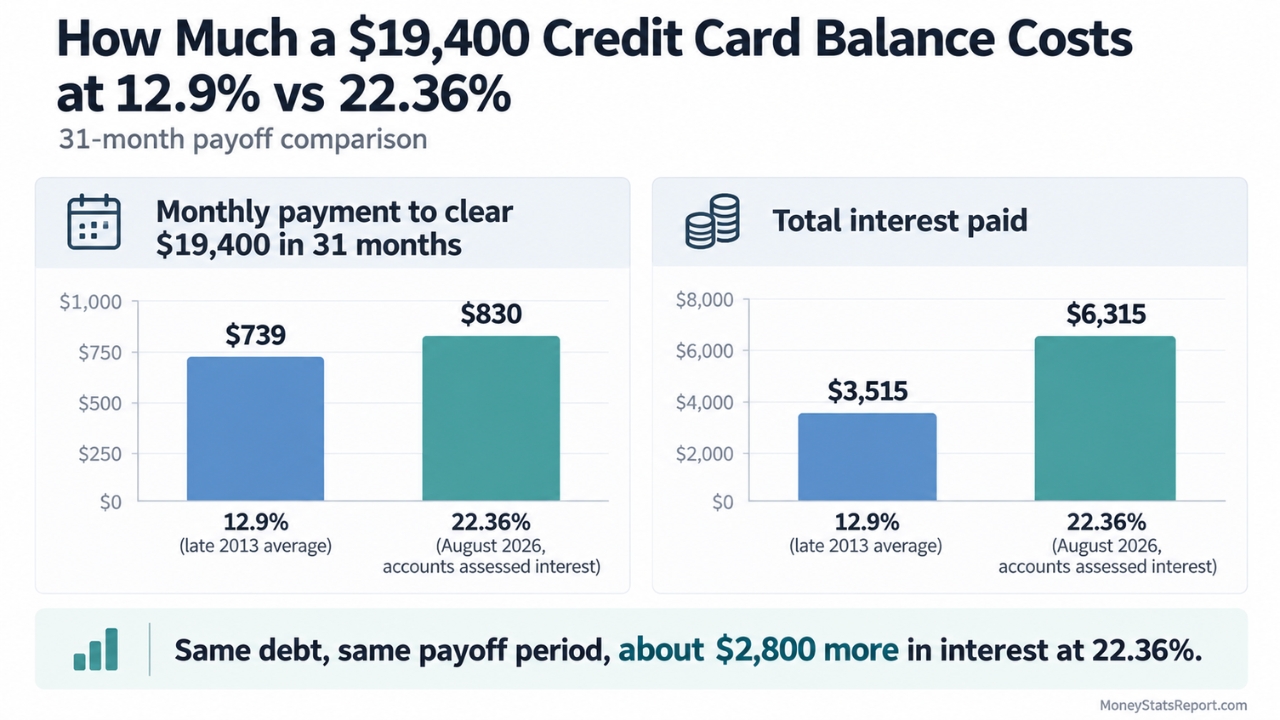
Same debt, same discipline, about $2,800 more in interest. That is not nothing. Bippy would call it a lifetime supply of squeaky toys.
Why Two Reports Disagree on Card Debt
Readers often ask why one report says Americans owe $1.35 trillion in revolving credit and another says $1.26 trillion.
Nobody is fudging anything. The two reports count different things in different ways.
Did You Know?
The revolving credit figure in the Federal Reserve G.19 consumer credit release includes more than credit cards, such as prearranged overdraft plans. By contrast, the New York Fed household debt report uses credit report data and counted $1.263 trillion in card balances in the second quarter of 2026, up $54 billion from a year earlier.
It also found that 6.97% of card balances moved into serious delinquency on an annualized basis, barely changed from 6.93% a year before.
Our breakdown of what Americans owe in 2026 covers the full household picture, mortgages included. The short version still holds. Card debt is the smaller pile with the bigger bill.
What to Check on Your Own Cards This Month

Our usual rule is one thing to do. October gets four, because rates and balances moved in opposite directions at once.
- Find your actual APR on your last statement. Not the national average, yours.
- Check whether that rate is variable. If it is, expect it to follow the September hike.
- Compare it with a fixed-rate personal loan. Banks averaged 11.90% on 24-month loans in August, roughly half the card rate, though your own offer depends on your credit.
- If your rate jumped after a payment more than 60 days late, six on-time minimum payments in a row should bring the old rate back under CFPB rules.
Write the APR on a sticky note and put it on the card itself. A number you can see is harder to ignore.
What Comes Next

The next G.19 release, with September data, is due in November. Because the Fed collects card rates only once a quarter, the first reading taken after the September hike will likely not arrive until early 2027.
Rather than guessing what that reading will show, there is something more useful to do now. Write down the APR on each card you carry and check which ones are variable. Anyone carrying a balance at 22.36% has a reason to start tonight.
Know your numbers people.