
 MoneyStatsReport Editors
In this article
- What the New York Fed Reported for April Through June
- Why Homeowners Borrow Against the House Instead of Refinancing
- The HELOC Market Is Not Repeating 2005
- The September Rate Hike Reached HELOC Bills Within Days
- Who Feels the Increase First
- The Payment Jump Nobody Mentions at Closing
- What Comes Next for the $459 Billion
- Frequently Asked Questions
Americans owed $459 billion on home equity lines of credit at the end of June, according to the New York Fed.
That is $48 billion more than a year earlier and $13 billion more than in March. The balance alone shouldn’t scare you. The price of carrying it changed.
Since the Federal Reserve raised rates on September 16, the prime rate that most HELOCs follow sits at 7.00%. In simple words – a debt that grew all year just got more expensive to keep.
What the New York Fed Reported for April Through June

The New York Fed quarterly household debt release came out August 11 and covers the second quarter of 2026. HELOC balances rose for the 17th quarter in a row, as Yahoo Finance noted in its coverage of the report.
| Debt type | Balance, Q2 2026 | Change from Q1 2026 | Change from Q2 2025 |
| HELOCs | $459 billion | +$13 billion | +$48 billion |
| Mortgages | $13.12 trillion | −$74 billion | +$182 billion |
| Credit cards | $1.26 trillion | +$21 billion | +$54 billion |
| All household debt | $18.8 trillion | −$13 billion | +$383 billion |
Two corrections before anyone panics. The “13” in some headlines means $13 billion in one quarter, not 13% growth.
The yearly gain works out to about 11.7%, by my arithmetic. The $74 billion mortgage drop was not a nation paying off houses, either. The Fed linked it to a reporting gap.
For a wider view of household debt, we also looked at U.S. mortgage debt and credit card balances. HELOCs account for a relatively small share of the total.
Why Homeowners Borrow Against the House Instead of Refinancing
Many homeowners locked in mortgage rates near 3% when they bought or refinanced in 2020 and 2021. Few of them want to trade that loan for a new one at more than twice the rate.
The 30-year fixed rate averaged 7.28% on October 1, according to Freddie Mac weekly mortgage survey data, up from 6.34% a year earlier.
View this post on Instagram
A HELOC gets around that. You keep the cheap first mortgage and borrow a second layer on top. The lenders and economists Yahoo Finance spoke with described three common reasons.
Homeowners with extra cash can also consider a mortgage recast. It reduces the required payment on an eligible existing loan without replacing its low interest rate or adding another debt.
Homeowners with a SOFR-based adjustable-rate mortgage face another risk because their first mortgage rate can change after the initial fixed period.
- Keeping a low first-mortgage rate instead of refinancing the whole balance
- Paying off credit cards that charge far more interest
- Funding renovations or, for some owners, an investment property
All three make sense on paper. The catch is that the second layer floats while the first stays put.
The HELOC Market Is Not Repeating 2005

In the mid-2000s, a HELOC was sometimes part of the down payment itself. A first mortgage covered 80% of the purchase price, and a home equity line covered most of the rest. Buyers walked in with almost no equity, and when home prices fell, many had little cushion left.
The current numbers look calmer. HEL News counted 13.29 million open HELOCs in the quarter, with the average balance up to $34,537 from $31,184.
Borrowers used 43% of their available limits, compared with 41% a year earlier. Lines 90 or more days late rose slightly to 0.99%. Even the $459 billion total remains below the $473 billion owed at the end of 2016.
A HELOC is an open-end line of credit secured by your home. The Consumer Financial Protection Bureau explains that lenders can freeze or cut the line if home values fall sharply, and missed payments can end in foreclosure.
The September Rate Hike Reached HELOC Bills Within Days
On September 16, the Fed raised its benchmark range a quarter point, to 3.75% to 4.00%, according to the Federal Open Market Committee statement. It was the first increase since July 2023.
The Federal Reserve raised its benchmark interest rate by a quarter-point to a range of 3.75% to 4%, aiming to curb persistent inflation amid solid economic activity. https://t.co/2RLTu3aACM https://t.co/z5XLXulmJs
— FOX26Houston (@FOX26Houston) September 16, 2026
Banks moved the same afternoon. U.S. Bank raised its prime rate to 7.00% from 6.75%, effective September 17, and other large banks followed. The September HELOC rate increase matters because most lines charge prime plus a margin, so the new rate can show up on your next statement.
Quick math on a $50,000 balance gives about $10.42 more a month. On the average balance of $34,537, the increase comes to roughly $7.20. Not a crisis. Also not nothing.
Did you know? The Fed does not set the prime rate. Each bank sets its own, and large banks usually keep it 3 percentage points above the top of the federal funds range.
Who Feels the Increase First
Rolling credit card debt into a home equity line can look like a clean fix. The cards drop to zero, and the monthly payment often shrinks.
The risk comes afterward. Clearing the cards can feel like progress, but if the balances build back up, the household ends up carrying both the old debt, now secured by the house, and new card debt on top of it.
Plenty of people use a HELOC well. Some borrowers, though, feel each quarter-point faster than others.
- Owners in the draw period paying interest only, since every rate change hits the whole payment
- People who moved card debt onto the house and then ran the cards back up
- Borrowers using most of their limit, who have little room if the lender trims the line
- Anyone whose draw period ends within the next year or two
None of that is a moral failing. It is simply where the math lands hardest.
The Payment Jump Nobody Mentions at Closing
Most HELOCs have two phases. The draw period, often 10 years, lets you borrow and pay only interest. The repayment period, often 10 to 20 years, ends the borrowing and adds principal to every payment.
The example below uses our own assumptions, not a quote from any lender, with a $50,000 balance at 7.50%, which equals prime plus a 0.50 margin.
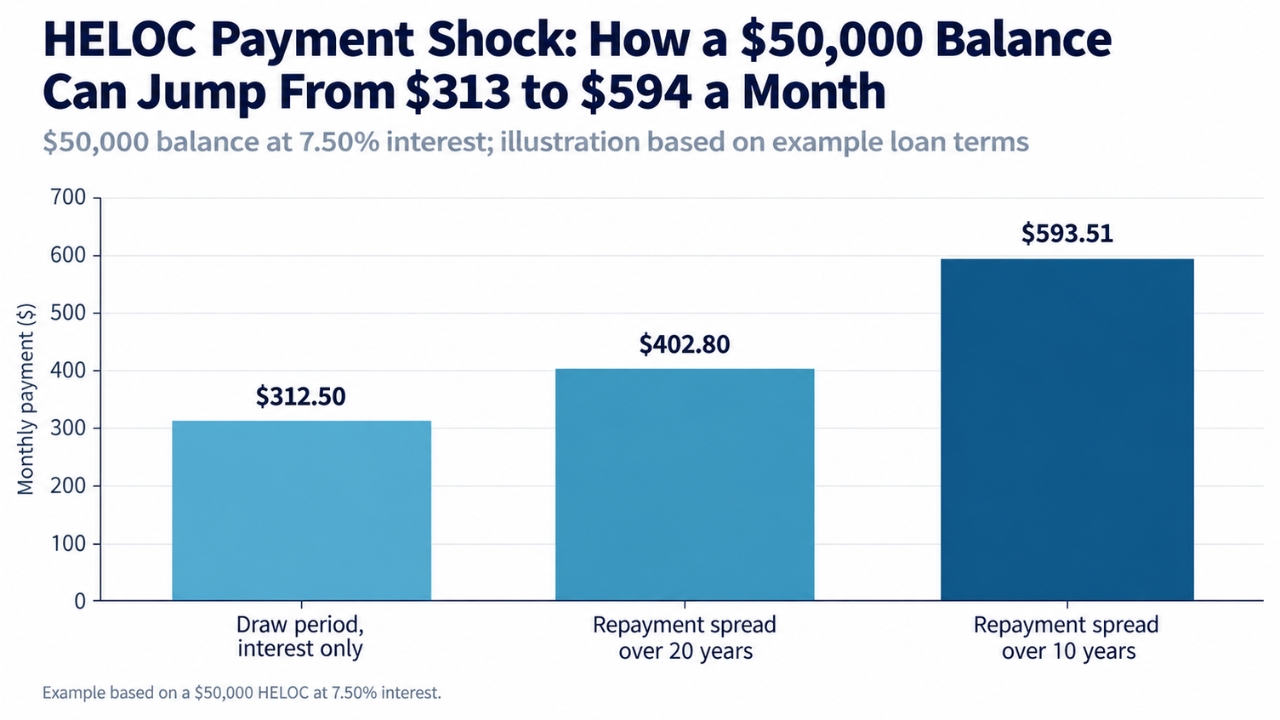
Same debt, same rate, and the bill nearly doubles under the 10-year schedule. Anyone who opened a line in 2016 with a 10-year draw could reach that switch this year. Your loan agreement lists the exact date.
What to Do With a HELOC This Month
The first steps are boring on purpose:
- Find the margin on your agreement and confirm the new rate on your October statement.
- Write down the day your draw period ends.
- Pay some principal now, even $50 a month, while payments are still interest-only.
- Ask your lender whether you can convert part of the balance to a fixed rate, and what that costs.
- Stop drawing for anything that will not outlast the debt.
It is also worth checking how much the HELOC payment leaves for retirement contributions. The latest BLS data on retirement benefits access and participation show that 72% of private-sector workers have access to a plan, but only 52% participate.
A separate risk appears after a job change. Vanguard found that IRA rollover money can remain in cash for years if the account owner never selects an investment.
The Fed met on October 27 and 28, according to the Federal Reserve meeting calendar. Whatever the decision, the steps above work the same way, because they depend on your own statement, not on a forecast.
What Comes Next for the $459 Billion

The June figures were collected before the September hike, so they show demand at a 6.75% prime. The third-quarter report, which the New York Fed usually publishes in early November, will be the first to cover any HELOC borrowing after the hike. We will open it on a Saturday morning.
If balances keep climbing at 7.00% prime, homeowners are choosing the line with their eyes open. If they flatten, the rate did its job. Either way, check your statement before then. Your number matters more than the national one.
Frequently Asked Questions
1. Is HELOC Interest Tax Deductible?
Only in limited cases. Under IRS Publication 936 on home mortgage interest, interest qualifies only if the money was used to buy, build, or substantially improve the home securing the line, and only if you itemize. Interest on a HELOC used to pay off credit cards does not qualify.
2. How Is a HELOC Different From a Home Equity Loan?
A home equity loan pays you one lump sum, usually at a fixed rate, with equal monthly payments from the start. A HELOC works more like a credit card secured by the house. You borrow what you need, when you need it, at a rate that moves.
3. Is There a Limit on How High My HELOC Rate Can Go?
Yes. Federal Regulation Z rules on maximum interest rates require a variable-rate line secured by a home to state a lifetime rate ceiling. Look for it in your agreement now, before you ever need it.