
 MoneyStatsReport Editors

In this article
- The climb happened quickly
- The Fed mattered, but it did not set your mortgage rate
- What 7.03% means on a $400,000 home
- Borrowers are already changing course
- A lower initial rate can come with more risk
- The housing market was already under pressure
- Frequently asked questions
- Does a 7% mortgage rate mean lenders are charging everyone 7%?
- Can paying mortgage points lower the interest rate?
- Does a larger down payment always get a lower mortgage rate?
- Can a buyer negotiate the mortgage rate with a lender?
- What happens if mortgage rates fall after I lock?
- What you should do with the 7% headline
The 7% mortgage rate is back, and you can already hear buyers asking the same question: “Does that number mean I should stop looking?”
Freddie Mac put the average 30-year fixed mortgage at 7.03% on September 24, 2026, the first reading above 7% since January 2025.
Some of us spent years around mortgage files, and one thing never changed. A round number gets attention, but the monthly payment decides the deal.
Seven percent is not a cliff. It is, however, expensive enough to change what many households can comfortably borrow.
The climb happened quickly
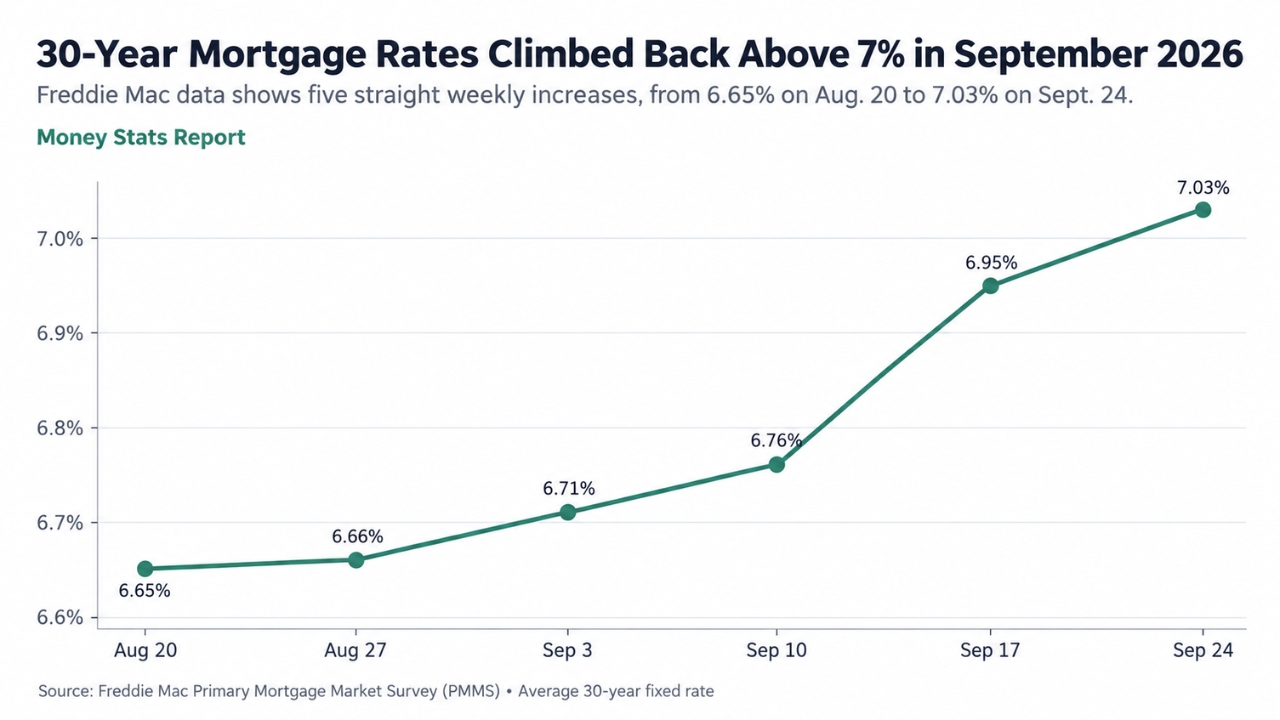
Freddie Mac’s Primary Mortgage Market Survey shows the 30-year fixed rate moving from 6.65% on August 20 to 7.03% on September 24. That was five straight weekly increases.
The 15-year fixed rate reached 6.42%, up from 6.26% one week earlier. A year earlier, the 30-year average was 6.30%.
Borrowers often focus on the first digit of a rate quote, as if 6.99% and 7.00% lived in different zip codes. They do not. Still, the direction matters.
A few tenths of a percentage point can take tens of dollars a month from the same household budget, and that adds up quickly over a long loan.
The Fed mattered, but it did not set your mortgage rate
On September 16, the Federal Reserve raised its target range by a quarter point to 3.75% to 4.00%, saying inflation remained elevated. Mortgage rates don’t move one-for-one with the federal funds rate.
View this post on Instagram
They respond more directly to the bond market, especially longer-term Treasury yields. The 10-year Treasury yield was 5.01% on September 18 and 5.18% on September 24.
Variable-rate home equity lines react differently. HELOC rates saw their largest weekly increase of 2026 after the Fed’s September decision, as many HELOCs follow the prime rate rather than longer-term Treasury yields.
Credit cards have their own rate story. The August credit card rates report put the average APR at 21.19%, before the September increase.
People reacted differently when a quote crossed from 6.99% to 7%, even though the mathematical difference was tiny.
What mattered was what had happened over the previous few weeks. A borrower who had built a budget around August’s rate could suddenly be looking at a noticeably different payment in September.
What 7.03% means on a $400,000 home
Here is the calculation we would put on a yellow pad for a borrower. Assume a $400,000 purchase price, a 20% down payment, and a $320,000 30-year fixed mortgage at 7.03%.
Principal and interest come to about $2,135.42 a month. At 6.65%, the payment would be about $2,054.29, so the late-summer rate increase adds roughly $81 a month before taxes or insurance. If the borrower kept that 7.03% loan for all 360 payments, total interest would be about $448,751.
| Example | Amount |
| Home price | $400,000 |
| Down payment | $80,000 |
| Loan amount | $320,000 |
| Monthly principal and interest | $2,135.42 |
| Total interest over 30 years | $448,750.92 |
| Total of 360 principal-and-interest payments | $768,750.92 |
Disclaimer: The example is illustrative only. It excludes property taxes, homeowners insurance, mortgage insurance, HOA fees, closing costs, points, and other expenses. For advice about your own finances or mortgage choice, consult a qualified professional.
Borrowers are already changing course

Different mortgage surveys use different samples, so their rates will not match exactly. The Mortgage Bankers Association reported 7.12% for conforming 30-year fixed loans in the week ending September 18.
Applications fell 1.5%, and adjustable-rate mortgages reached 9.8% of applications. The next MBA release on September 30 put that fixed rate at 7.30% for the week ending September 25.
Application volume fell another 6%, while purchase applications dropped 4% and refinance applications fell 9%. The ARM share rose to 10.3%.
We see this pattern repeatedly in lending, especially around rate spikes. When fixed rates bite, borrowers start looking sideways for a lower opening payment.
Sometimes that is sensible. Sometimes it is just a cheaper first payment wearing a nicer shirt.
A lower initial rate can come with more risk
MBA said 5/1 adjustable-rate mortgages averaged 6.47% for the week ending September 25, below its 7.30% fixed-rate figure. That gap explains some of the renewed interest in ARMs.
U.S. MORTGAGE RATES SURGE TO 7.30%
The average 30-year fixed mortgage contract rate climbed to 7.30%, up 18 basis points in one week and 84 basis points year-over-year, according to the MBA.
The 15-year fixed rate rose to 6.56%, while the 5-year adjustable rate jumped 37 basis points to 6.47%.
Rising borrowing costs are adding further pressure to U.S. housing affordability.
— *Walter Bloomberg (@DeItaone) September 30, 2026
The lower starting payment is real. So is the possibility that the rate resets higher later.
The Consumer Financial Protection Bureau warns borrowers not to assume they will be able to refinance before an adjustable rate changes. The finance oriented brains like boring questions:
- Can the payment still fit if the ARM adjusts upward?
- How long do you realistically expect to keep the home?
- What are the adjustment caps, fees, and total loan costs?
- Would a seller-paid buydown improve the first years without weakening your cash reserves?
A refinance later can help if rates fall and you still qualify. It shouldn’t be the plan holding the deal together.
The housing market was already under pressure

Higher mortgage rates arrived in a market that was hardly sprinting. The National Association of Realtors reported that existing-home sales fell 2.0% in August from July and 1.2% from a year earlier.
Americans already carry $13.1 trillion in mortgage debt, which puts the latest rate increase into a much broader household debt picture. On top of that, home equity line of credit debt reached $459 billion in June, up $48 billion over the previous year.
That doesn’t mean every buyer should walk away, and national data cannot price your neighborhood. Local inventory, price cuts, seller concessions, taxes, and insurance can matter more than a national average.
During my underwriting years, two borrowers with the same income could have very different outcomes because one had cash left after closing and the other did not.
In plain English: don’t let a rate headline make the whole decision. Run the payment, keep a reserve, and look at the actual deal in front of you.
Frequently asked questions
Does a 7% mortgage rate mean lenders are charging everyone 7%?
No. National averages are benchmarks. Your quote can differ with credit, loan type, down payment, lender pricing, points, and the day you lock.
Can paying mortgage points lower the interest rate?
Yes. Discount points are upfront fees exchanged for a lower rate. Compare the upfront cost with the monthly savings and your expected time in the loan.
Does a larger down payment always get a lower mortgage rate?
No. A larger down payment can improve pricing and reduce mortgage insurance in some cases, but the rate still depends on the full loan profile.
Can a buyer negotiate the mortgage rate with a lender?
Yes. Compare lenders on rate, fees, points, and credits. Loan Estimates make that comparison clearer than a rate quote by itself.
What happens if mortgage rates fall after I lock?
A standard lock protects against increases, but it may not automatically drop if rates fall. Some lenders offer float-down options under specific terms.
What you should do with the 7% headline
@cnbc The average rate on the popular 30-year fixed #mortgage crossed over 7% on Thursday for the first time since May 2025, hitting 7.07%, according to Mortgage News Daily. Read more at the #linkinbio or the link on screen. #CNBC ♬ original sound – cnbc
Treat 7.03% as a budget signal, not a command to buy or wait. Pull the actual Loan Estimate. Check the principal and interest, then add taxes, insurance, dues, maintenance, and the cash you will still have after closing.
Also check how much that mortgage payment leaves for retirement contributions. The latest BLS data on retirement benefits access and participation show that 72% of private-sector workers have access to a plan, but only 52% participate.
Rates may fall. They may rise. Refinancing may become attractive, or it may not be available when you want it. Buy the payment you can carry today.
For homeowners with low fixed rates, a mortgage recast offers another option: make a lump-sum principal payment and reduce the monthly bill without replacing the existing loan.
A divorce can create a similar problem for couples with low-rate loans. Our guide to joint mortgage liability after divorce explains why one spouse can still owe the debt after a court assigns payments to the other.