
 MoneyStatsReport Editors

In this article
- What is the HELOC rate?
- The increase followed the Fed’s September decision
- Your contract decides when the higher rate arrives
- What a quarter-point increase costs each month
- Home equity doesn’t cover a monthly payment
- A fixed rate can help, but compare the full cost
- Moving card debt onto the house changes the risk
- Check the repayment date as carefully as the rate
- Frequently asked questions
- 1. Is HELOC interest tax-deductible?
- 2. Can the lender freeze unused credit?
- 3. Can I cancel after opening the account?
- 4. What happens if I sell my house?
- 5. Does the hike change my existing fixed mortgage rate?
- Get your next payment confirmed before borrowing more
Mortgage and home equity news can change a household budget faster than most headlines suggest.
A Bankrate survey from September 23, 2026, put the average rate for a $30,000 home equity line of credit at 7.28%, up 17 basis points in a week. Bankrate called it the largest weekly increase of the year, following the September 16 rate hike by the Federal Reserve.
For homeowners carrying a variable balance, the news is worth translating into dollars before making another draw. On a $30,000 balance, a rise of 0.17 percentage points adds roughly $51 a year in interest, or a little over $4 a month. A small rate change can quickly become a recurring expense, and several increases in a row add up.
What is the HELOC rate?
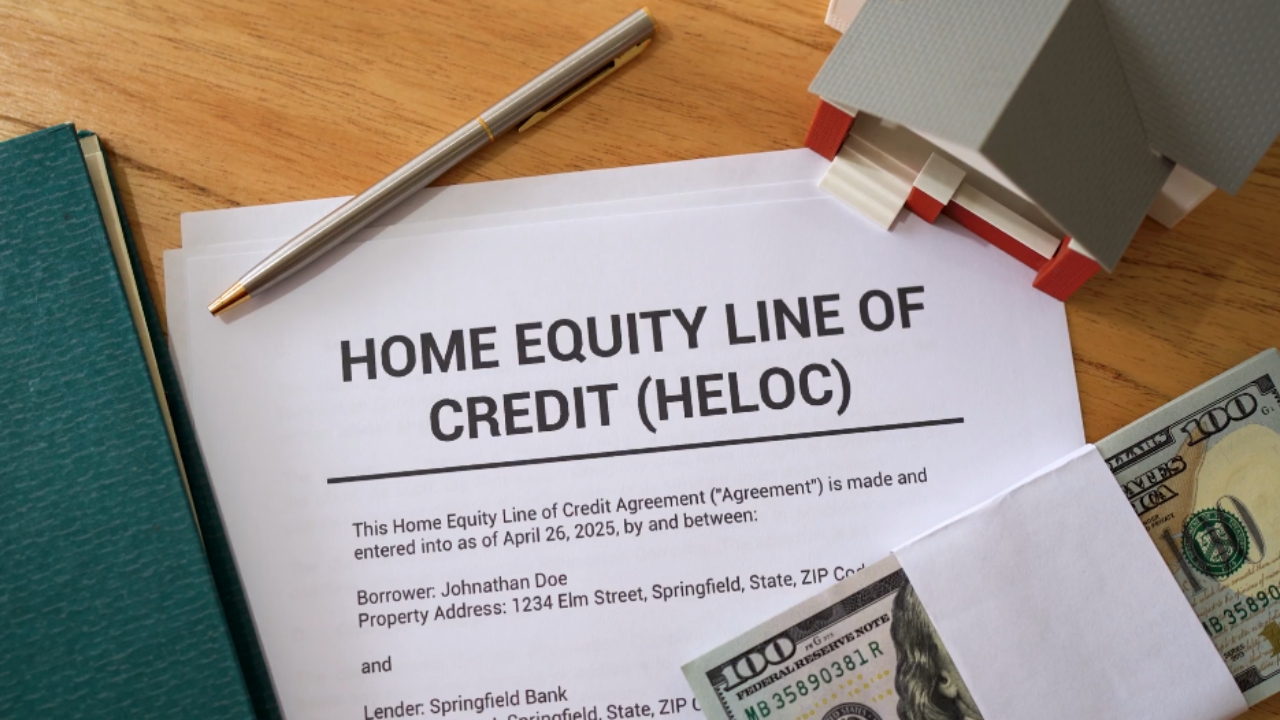
For all of you who didn’t know, a HELOC interest rate is the annual percentage a lender charges on money you borrow through a home equity line of credit.
HELOC stands for Home Equity Line of Credit. It lets you borrow against your home’s equity, which is your home’s value minus your remaining mortgage debt. Your home secures the borrowing.
For example:
- Your lender approves a $50,000 credit limit.
- You borrow $20,000.
- At an 8% annual interest rate, that balance costs $1,600 a year, or about $133 a month in interest, assuming the balance and rate stay unchanged.
Interest applies to the amount borrowed. Fees and repayments toward the original debt can add to your payment.
Most HELOC rates are variable, meaning they can rise or fall during the loan. Higher rates mean higher interest costs on the same balance. Because your home is collateral, failing to repay can put it at risk.
Learn this please, you will need it!
The increase followed the Fed’s September decision
The Federal Reserve’s September 16 statement confirmed a quarter-percentage-point increase, taking its target range from 3.50%–3.75% to 3.75%–4.00%. Officials said inflation remained elevated and the action would support a return to their 2% goal.
A week later, Bankrate’s surveyed HELOC average rose from 7.11% to 7.28%. That’s a 0.17-percentage-point increase, not a 17% jump.
A HELOC rate increase works differently than a rise in 30-year mortgage rates. Homeowners with existing fixed-rate mortgages keep their contracted interest rates.
View this post on Instagram
The survey assumes a $30,000 line, a 700 FICO score, and combined home debt equal to 80% of the property’s value. It isn’t a personalized quote or a measurement of every existing account.
We check those assumptions before comparing rates. Two applications can look similar on the first page and tell different stories underneath. In this case, September 23 is the measurement date, so the figure should not be presented as a September 30 quote.
Your contract decides when the higher rate arrives
A HELOC is a revolving borrowing secured by your home. Most carry variable rates, often calculated using the prime rate plus a lender’s margin.
A HELOC typically follows the prime rate, but SOFR-based adjustable-rate mortgages use a different index and specific interest rate caps.
The Fed influences that chain, but banks set their own prime rates. The central bank doesn’t directly set your HELOC rate.
The CFPB’s explanation of variable HELOC pricing is worth keeping beside your agreement:
- The index is the reference rate your contract follows.
- The margin is the additional percentage the lender adds.
- Adjustment dates, introductory periods, floors, and caps affect what you pay.
Don’t assume every balance rose 17 basis points because the survey did. An existing prime-linked account could move differently.
Loan agreements get our full attention. The adjustment clause tells you when a policy announcement becomes your expense.
What a quarter-point increase costs each month
A quick estimate needs nothing more than a napkin. Multiply the outstanding balance by 0.0025, then divide by 12. The result is the approximate extra monthly interest from a full quarter-point increase. On a $30,000 balance, that works out to about $6.25 a month.
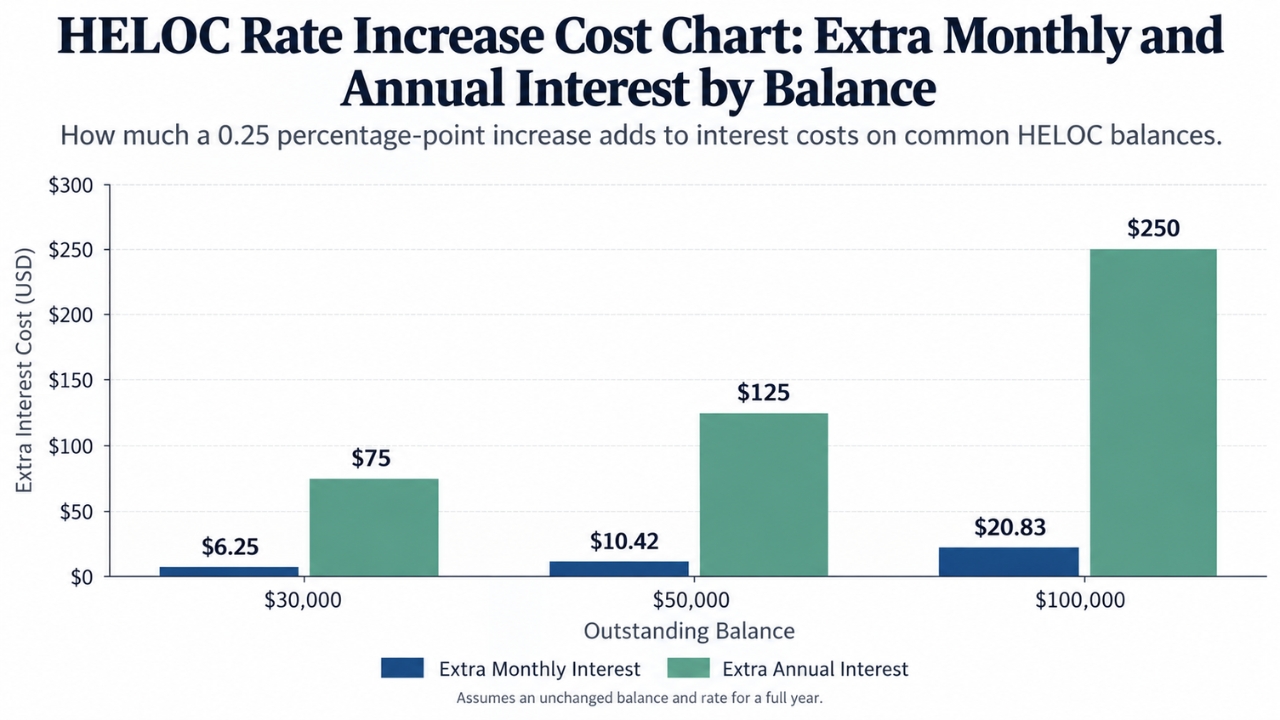
Those estimates assume the balance and rate stay unchanged for a full year. Actual billing depends on daily balances, how the lender calculates interest, and the repayment terms. The figures show added interest, not full loan payments.
For comparison, the 17-basis-point increase in the survey adds $4.25 in monthly interest on $30,000 using the same method. At 7.28%, monthly interest alone on that balance would be $182.
A hypothetical rise of one full percentage point makes a useful stress test. On a $50,000 balance, it would add $41.67 a month. The number is a budget check, not a forecast.
Home equity doesn’t cover a monthly payment
A paid-off or mostly paid-off home frees up room in a monthly budget, but it does not turn the walls into spendable income. Borrowing against that equity puts a new obligation back into the budget.
Consider a hypothetical $400,000 home with a $240,000 mortgage. The owner has $160,000 in equity. If a lender allows combined borrowing up to 80% of the home value, the additional borrowing ceiling would be $80,000, before other restrictions.
National figures on U.S. mortgage debt show the scale of outstanding home loans across the country, but those totals say little about how much additional debt an individual homeowner can afford.
The latest New York Fed figures put home equity line of credit debt at $459 billion, up $48 billion over the previous year.
Equity measures ownership value. Available credit measures potential borrowing. Neither figure shows that a household can afford the payments.
BREAKING: US household equity exposure now accounts for a record 39.9% of household net worth.
This figure has surged +12.6 percentage points since the 2022 bear market.
Over the same period, owners’ equity in residential real estate as a % of household net worth has declined -3.5 percentage points, to 19.3%, its lowest proportion since Q2 2021.
This metric measures the market value of homes minus outstanding mortgage and home loan debt held by households, as a % of total household net worth.
As a result, the gap between equity exposure and real estate exposure has risen to a record 20.6 percentage points.
To put this into perspective, real estate exposure peaked at 24.1% in Q3 2005, during the housing boom, and was 1.0 percentage point above equity exposure.
Household wealth has never been this skewed toward equities.
— The Kobeissi Letter (@KobeissiLetter) September 21, 2026
Rising property values do not protect homeowners against higher payments; the Fed survey on unpaid bills shows how often cash flow falls short.
A fixed rate can help, but compare the full cost

Some lenders let borrowers convert part or all of a HELOC balance to a fixed rate. The CFPB notes that the fixed rate is usually higher than the variable rate, although it offers more predictable payments.
Ask for the conversion rate, fees, minimum balance, repayment term, and monthly payment in writing. Then compare the total cost over the period you expect to keep the debt.
A separate home equity loan provides a lump sum. Verify its terms rather than assuming every such loan has a fixed rate.
A modest rate increase alone doesn’t establish that replacing a loan, with new costs attached, will save money.
If you want a lower payment on an existing fixed-rate mortgage, you could also check mortgage recast eligibility before considering a refinance. The old interest rate stays in place, provided the servicer approves the recast.
Moving card debt onto the house changes the risk
When a credit card balance barely seems to move, a lower interest rate is easy to find appealing.
Consider a hypothetical $12,000 card balance paid off over 36 months. Using the rates from our credit card rates comparison, the payoff would cost about $4,580 in interest at 22.36%, compared with about $2,530 at 12.9%. The lower rate saves roughly $2,000.
But the warning from the CFPB about using home equity for debt consolidation deserves attention. Falling behind can put a home at risk of foreclosure. A longer repayment period can also increase total costs, even with a smaller monthly payment.
Before making that move, two things are worth having on paper.
- A payoff schedule that includes fees and a higher-rate scenario.
- A budget that does not depend on building the card balances back up.
Moving debt does not erase it. A payoff plan works only when the balance actually reaches zero.
Check the repayment date as carefully as the rate

The rate headline is useful, but don’t let it distract you from the draw period’s ending date. When borrowing ends, principal repayment can make the payment rise even without another Fed hike. Some agreements require a balloon payment.
Read the fees a HELOC lender may charge and ask four questions:
- What will my next payment be at the updated rate?
- When does principal repayment begin, and what payment is projected?
- Are there annual, inactivity, conversion, or early-closure charges?
- What happens when any introductory discount expires?
For new borrowing, compare written estimates using the same amount and repayment period.
Any explanation that spends more time on the starting payment than on what comes afterward deserves suspicion.
Frequently asked questions
1. Is HELOC interest tax-deductible?
Potentially, if you itemize and meet IRS home-improvement and debt-limit rules. Interest on personal credit-card consolidation isn’t deductible.
2. Can the lender freeze unused credit?
Yes, under permitted conditions, including a significant property-value decline or qualifying deterioration in repayment ability. Unused credit isn’t guaranteed emergency cash.
3. Can I cancel after opening the account?
For a principal residence, a three-business-day cancellation right generally applies. Follow the notice’s timing and written-delivery requirements.
4. What happens if I sell my house?
You generally must repay the HELOC in full when selling. Request a payoff figure before calculating your expected proceeds.
5. Does the hike change my existing fixed mortgage rate?
No. An existing fixed mortgage rate stays unchanged. A separate variable-rate HELOC can still adjust under its own contract.
Get your next payment confirmed before borrowing more

Ten minutes spent checking a statement are more useful than ten minutes spent guessing what the Fed might do next. The number that matters is the payment your household must actually cover.
Find your current balance, index, margin, and next adjustment date. Ask the lender to confirm the upcoming payment and the payment after the draw period ends. Put both beside your monthly expenses before authorizing another withdrawal.
Retirement contributions deserve protection in that budget too. The latest retirement benefits access and participation data show that access to a workplace plan does not guarantee employees actually contribute.
If either payment leaves too little room for essentials, reconsider the amount or timing of the borrowing.